
Bringing A Boy Home: Never Say Never
Bringing a Boy Home: Never Say Never
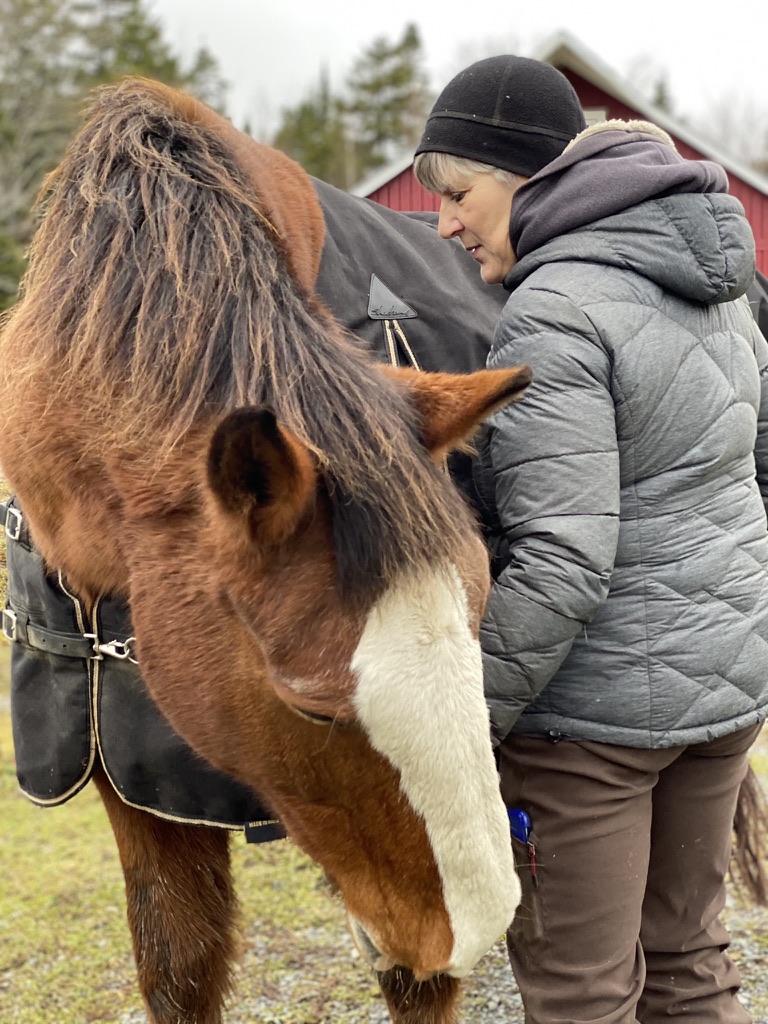
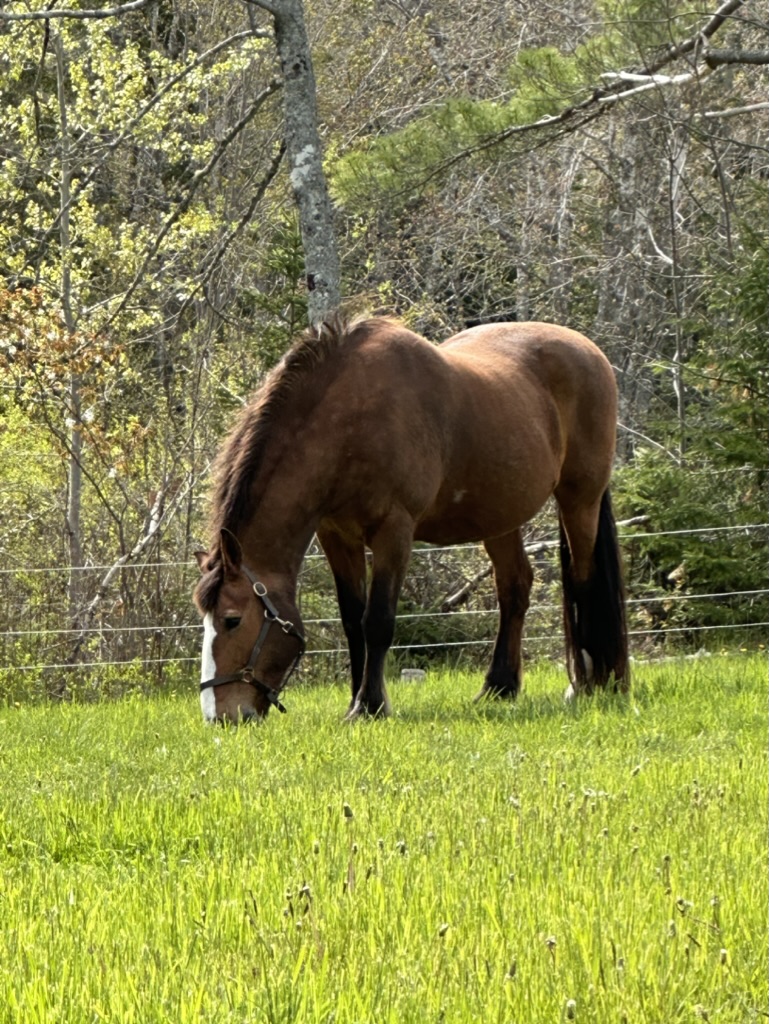
Navajo, a big beautiful Clydesdale, Quarter horse, Belgian Cross was born in 1995 in Newfoundland at my mother’s place in a small east coast community called Winterton. He lived there until he was seven. As my folks aged, they were challenged to keep up with the physical work required to look after horses. Their barn was well equipped for summer – three spacious stalls and a large well aired hay loft but no running water. It was easy in the summertime to run a hose from the house to the barn to supply the water. With winter temperatures well below freezing running a hose wasn’t an option. There used to be a saw mill in the community where they could get sawdust for free. When it closed, it became difficult to get bedding for the stalls. Mom kept Navajo’s mother Royal until she was twenty-two. Royal was rehomed to Nova Scotia, and after six months in her new home, she was rehomed again, to me. A friend helped us by providing temporary boarding for Royal until we could find her a permanent home.
My hubby Wayne and I didn’t intend to own horses, nor did we have the property to house them. We searched for suitable homes to board Royal but found nothing that met our criteria. As a senior, we wanted her to have lots of space to roam, graze, and just ‘be a horse’ in a friendly herd. We gave up the search for a boarding facility and decided we needed to find a place where we could all be together.
We started looking for a new home with a barn and land for grazing. We found the ideal spot after about a year and a half of searching. By the time we moved into Stage Road in Enfield, we had Royal, two other horses, and a minature donkey. All four-leggeds were either boarded or living with their original owners until we took possession of our new place. Just one was missing. Navajo.
Not knowing Navajo’s fate troubled me. I often told Mom, “If I could ever find Navajo, I would have him here in a heartbeat.” She admitted hearing those words made her heart ache and she believed it was impossible.
On January 4, 2019, during my usual daily call to Mom, something felt different. I could hear her muttering to her husband Frank in the background. He wanted her to tell me something. She was reluctant. “Mom, what is it? What’s wrong? What are you not telling me?”
At first, she said nothing. But I pressed… using that tone I sometimes need to use with Mom: ‘I’m serious, don’t mess around with me, spill it!’ She told me that when they were out on New Year’s Eve, the man who owned Navajo’s father approached them and said he thought he’d seen Navajo for sale on a Newfoundland buy-and-sell website.
Well now you can imagine how my ears perked up. “Oh. Where? What website?”
“I don’t want you to do anything about it,” Mom said.
I lied. “I won’t. I just want to look.”
In the meantime, my fingers were flying across my keyboard, and I was looking for the website.
There he was. For sale. I don’t know if there’s a single word to describe the emotion I felt. Joy, anxiety, trepidation, surprise, amazement, disbelief and hope were all wrapped up together. She was concerned I would inquire. Mothers sometimes think they know what’s best for their offspring, even when the offspring are almost senior citizens themselves. Wayne and I had just lost thirty year old Royal a few months prior and had adjusted to being the owners of three horses and a donkey. Mom didn’t think we needed to take on the extra work of a fourth horse. Sometimes mothers are just plain wrong.
Wayne and I both work from home, and often we need to go for a drive to shake off the day’s events. A place where we can have a conversation without a telephone or a computer in our immediate space. After Mom’s call, we both knew we needed a drive. We pulled into the Tim Horton’s just off the highway in Windsor, Nova Scotia about an hour from our home. It goes without saying that I needed to make the telephone call to the seller to inquire about Navajo. So, in that parking lot, I called. A woman answered the phone. I asked, “The big horse in the pair you have for sale, is he named Navajo?”
“Yes.”
The flood of emotion took my breath away. I couldn’t speak. I started sobbing into the phone, and eventually, all I could get out was, “I’ll have to call you back.” And I hung up. Imagine. I hung up. Never before in my life have I had to hang up like that. Can only imagine what the woman must have thought.
God bless Wayne. He really is a saint. He just held me till I cried it out. I finally caught my breath and called her back. I gave her the whole backstory about Navajo being born to my mom’s horse and leaving when he was seven. This current owner had him for about three years. She said he was really overweight when she got him, and she worked hard to get him back to an optimal weight so as to prevent equine metabolic disorders.
She was selling him and his five year old pasture mate and wanted them to be sold together. A local couple had expressed interest in buying them. She told me that, because of his history with my mom and me, she would be prepared to say no to the others and yes to me.
“I need to think about it.” I wasn’t prepared for two, especially since the second horse was so young. I didn’t want to bring a youngster to Nova Scotia and have to sell him to somebody else if we became too old or ill to look after him. I did not have the same concern about Navajo. He was a senior at twenty-four. I didn’t know a lot about the state of his health and realized his time with me might be short-lived. Even if he lived ten years, that’s very different than taking on a five year old who could live to be twenty-five or thirty.
After a day and much conversation with Wayne I told her I couldn’t buy them. The conversation broke my heart. The pain in my chest was intense. I felt my throat closing over and could barely get the words out. It seemed like I was turning my back on an answer to prayer. The notion of having Royal here, which was never intended, her passing and then four months later Navajo is available and I have an empty stall just seemed impossible to pass up. But we did. We said no. I did say,” If the sale to the other interested party falls through, please contact me.” The current owner agreed.
Later in January, I was bound for Elephant Head Arizona for the final portion of a program to become a certified EPONAQUEST Instructor. EPONAQUEST was founded by Linda Kohanov. Linda offers, in addition to other services, educational programs where people work with horses to explore and learn life skills such as leadership, assertiveness, personal empowerment, relationships, intuition, and emotional fitness. Linda is a wonderful teacher, author, speaker, and is internationally recognized as an innovator in equine experiential learning. My being there was a dream come true.
While in Arizona, I was particularly bothered by Wayne’s and my decision not to buy Navajo. I was sharing accommodations at Reveling Ravens Retreat with a dear friend, Sarah V. Barnes, author of two books: She Who Rides Horses and A Clan Chief’s Daughter. Sarah is a wise and insightful woman with tremendous intuition and vision. As I relayed Navajo’s story, she said, “It’s not over. This is not over.” Somehow, I found that settling.
When I returned to Nova Scotia, I had been home only a couple of days when Navajo’s owner reached out to say the original sale had fallen through. She asked if I would take the horses. Wayne wasn’t home, and I knew I could not reach him all day. I asked her to give me until the next morning to decide. I spent the day going back and forth, trying to figure out how to make it work. Did we have the space to build an extra stall? Were we prepared to take the five-year-old? Could we afford another one? How would it affect our workload? How would it affect the herd?
All of my self-management skills were required to keep me grounded and calm so I could think. We simply don’t make good decisions when we are stressed or upset. When Wayne came home, I relayed what had transpired throughout the day. We talked about it for hours and finally decided to go to bed with a prayer the answer would be available to us when we woke.
In the morning, my first question to Wayne was, “What are we going to do?”
Being the joker he is, he asked, “About what?”
I said, “About Navajo.” He said to text her back and tell her we would take him, just him.
The words weren’t out of his mouth before the phone was in my hand, and I asked him to dictate. He’s more of a diplomat at times, and I wanted to get this right. We sent the seller a message saying we would take Navajo. We knew it might be a long shot because she really wanted them to go to a new home together. We just could not manage two more. One yes. Two, no. Later in the afternoon, I got a text asking me to arrange transportation. That was all it said. Well, you know my answer.
The task now was to find someone who could trailer him from Newfoundland to Nova Scotia. He was living on Random Island which is one of the largest islands off the coast of Newfoundland. It’s nestled in Trinity Bay south of the Bonavista Peninsula. It is connected to the mainland at Clarenville by an eleven-hundred foot causeway. Short run.
The owner had said he didn’t trailer well, so I was nervous about finding someone to trailer him and another horse so he wouldn’t be alone. I started by asking friends and calling equestrian barns in Newfoundland. One woman’s name kept coming up. I contacted her. She was incredibly helpful and could hear my anxiety. Not her first rodeo with an owner like me. I did not want Navajo to cross the North Atlantic in the winter. I planned to wait until we were on the other side of the winter storms to avoid a delay with the ferry leaving Port aux Basques, Newfoundland for North Sydney, Nova Scotia. He would be spending a long time in the trailer. By car, it’s almost eight hours across Newfoundland to the ferry, another six to eight on the ferry and four more to home once in Nova Scotia. It takes somewhat longer when hauling a horse trailer. I prayed for good weather and driving conditions.
In March, I made a quick decision to go to Newfoundland to meet with the woman who would be trailering Navajo and to see him. It had been seventeen years since I laid eyes on him and I didn’t realize at the time that it would be my last time. I wanted Mom and Frank to see him before he left the island. We headed out on a cold, rainy, foggy, soon-to-be-spring day. The first stop was to the woman who agreed to trailer him over. She talked about travelling on the Easter weekend and, as of then, didn’t have another horse scheduled for the ride. She said if she could not find another equine passenger, she would put one of her own on the trailer as a buddy for Navajo. Next stop, my boy.
The relief at seeing him again was immense. I had no idea how much grief over his departure from Mom’s place was being held within my body. It was as if all was going to finally be right in my world with horses. The wondering could stop. The ache would cease. The hole in my heart could close over.
It was quite an emotional experience for Mom and Frank, too. Now that he was coming to me, all we wanted was for him to be on my side of the gulf. After Mom and Frank were back in the car, I returned to the field to see Navajo and sent him a visual of where he would live – the image from the pasture closest to the house. I conjured up the land, green pastures and wide open spaces, the bright red run-ins that would protect him from the blazing sun and fall rains, and his four pasture mates; Ollie, a Thoroughbred, Quarter Horse, with a little bit of Arabian cross; Eco, a Registered Quarter Horse; Bosko, Clydesdale Quarter Horse cross and Jack, the miniature donkey. Jack came to us when he was just one year old. He was named after Jack Layton who, the day before Jack the donkey was born, won his riding in a federal election and became the leader of the official opposition in the federal government. Navajo’s soon-to-be forever home was vibrant with colour and surrounded by a forest of evergreens. The image I sent went with the silent heart-to-heart message of ‘this is going to be your forever home. I’ll be back for you.’
Once I got back to Nova Scotia I called an animal communicator and relayed the whole story. She told me he would be fine and he would not be alone. His momma would be there with him. I believe that. I can feel her here sometimes. I believe she orchestrated the whole thing anyway. Of course! Why wouldn’t she be there?
I asked Wayne if he would drive over and follow the trailer back. I wasn’t sure I could make the trip. While I am pretty good at managing my stress and anxiety, there was something about this journey that had me thinking it wouldn’t be good for me to be there. I did not want my worry to transfer to Navajo as he was about to embark on the final leg of his journey home. Wayne had already decided he was going to do this. His answer when I asked why, “If anything happens I want to be there not hear about it from someone else.” Between March and Easter, I changed my mind and knew I had to go.
I don’t like travelling on the ferry. I avoided it for years. There was no other way to get Navajo off the island. Wayne and I left at noon on the Thursday before Good Friday for the midnight crossing from Sydney, Nova Scotia to Port-aux-Basques, Newfoundland. We booked an overnight cabin for the ride over. The crossing was one of the smoothest sailings I had ever experienced. One miracle behind us. We encountered snow as we started our drive across the province on Good Friday. We wanted to make it to the hotel we had booked in Clarenville and then meet the trailer on Saturday morning.
We arrived at Navajo’s place well before the trailer. I wondered whether this would all come together, since the driver was running late and we needed to be back in Port aux Basques by early Saturday evening to make the midnight crossing back to Nova Scotia. The driver had experienced some difficulty loading one of the other horses she had booked after my visit with her. Now, for the moment of truth. Was Navajo going to get on this trailer?
I had not anticipated what was to come next. I was ready for trouble. The woman selling him haltered him and led him to the trailer. It was as if he could not get there fast enough. One whinny to the one he was leaving behind and onward to the trailer. He put his foot on the threshold before the second trailer door was fully open. He was ready to go.
I was about to become fast friends with a different kind of stress. The new momma kind! My boy in a trailer with someone else driving. Coherent breathing is a type of breathing that helps us shift our nervous system from fight – flight to rest and digest. From the sympathetic to the parasympathetic nervous system. Wayne and I often use it with the horses when they are heightened and scared. It works. So, I began coherent breathing. A lot.
One of the horses on the trailer was not making the trip to Nova Scotia. It had been sold to a man who made a living as a logger. We were three quarters of the way across Newfoundland when Wayne and I found ourselves following the trailer down this narrow logging road in the middle of nowhere, so this horse could be dropped off. I was not sure we would ever get out of there. The trailer ahead of us was so low to the ground I was waiting for it to get stuck or hung up on the rough track. There did not seem to be enough space to turn a Mini around, let alone a truck and a loaded four-slant-horse trailer.
Navajo was the last one on the trailer, so he had to get out for the other one to get off. As the driver backed him out and handed Wayne the lead line, the logger commented that Navajo was the kind of horse he needed for heavy logging work. The one he had purchased differed from the type of horse one took into the woods to do logging. She was tall, black, sleek, and elegant looking. Possible a Hanoverian or Thoroughbred. Clearly, she had been a performance horse and reminded me of a temperamental princess. I wondered about her previous handling. What had happened to make her so skittish? How had she been treated? What the heck would become of her here? I cringed when the man said she would end up in the pickle barrel if she did not work out. So when he commented again about Navajo, this big, strapping, solid, gentle draft breed known as the ‘working horse’ my self-talk said, “Not in this lifetime buddy! Not in this lifetime.” If I were honest, the words were quite stronger than that, but let’s leave it there for now. Later, Wayne told me he wondered if we should have bought her right there and then.
Navajo stood like a champion taking it all in. When asked to get back on the trailer he walked on as if he had been doing it every day. From there, it was on to the ferry terminal. The driver makes this trip quite often. It’s not her practice to take them off when she stops at the ferry. She checks to make sure they have lots of hay and water and settles them for the boat ride. Wayne and I made our way to our cabin for another midnight crossing. Miracle number two. A crossing just like the first. Unbelievable really in the middle of the North Atlantic through the Cabot Strait in March. Because of high winds, the ferries were unable to make the crossings on the weekends before and after we sailed.
The trip across Nova Scotia was uneventful. One stop just after we got off the ferry to make sure the four-leggeds were okay, and away we went. Approximately 72 hours from pulling out of our driveway, with almost 1200 kilometers driven and two ferry crossings made, we pulled back in with the trailer behind us and my boy home. The driver backed him out of the trailer for the final time. He took a big drink, walked with us to meet his pasture mates across the fence line, and then settled by himself into the back pasture for a well-deserved nap. Horses need to feel safe and secure before they can lie down. Even though they can sleep standing up, they only get their REM sleep when down. Either he was completely exhausted, or the spirit of his momma was still with him telling him he would be okay. Maybe both. He went flat out. He was home. Forever.
We allowed him time to settle in his new surroundings before integrating with the others. When it was time, we introduced Navajo to the others one by one so he could find his place amongst the herd. He is intelligent and learns quickly. He is a master at the equine-facilitated coaching work we do together. He has taught others, and me, so much in the few years he has been here. Every day is a blessing. He’s going to be thirty-one this year. This is his last stop. When it is his time to transition and cross the Rainbow Bridge, he will be laid to rest beside his momma. Another miracle.
